Wednesday, 30 March 2016

Why is mainstream media sinking into sleaze?

       Amazing what passes for news these days. In one popular daily, featured prominently among a host of nude celebrity selfies, a young woman is pictured with her trousers round her thighs as she urinates in the street – apparently caught short by her bladder and an ever-ready smartphone! 

       Elsewhere in the same newspaper, there’s a graphic shot of someone’s earwax - thought to be the biggest ever lump of candle grease ever fished out from a lug-hole. This after weeks of unedifying pus being popped from enormous pimples! 

       Hard to know which ‘story’ has been the most gut-churning. Was it the scandalous tale of a pretty blonde who, having failed to flush away her poo from her new boyfriend’s lavatory bowl, hid the offensive matter in her handbag? (Obviously, the girl was embarrassed, but not so overcome with shame she couldn’t share the experience with millions of readers. She was even willing to pose without a brown paper bag over her head!) 

       Or could it be yet another earth-shattering shot of a Kardashian bottom? The biggest blackhead in the world, perhaps? Or intimate details of a reality star’s underwear? 

       So what’s going on? Why are activities that should only take place in private now being paraded by leading newspapers and magazines? Why are images once confined to top-shelf sleazy rags being devoured with the Kellogg’s at breakfast? 

       It’s not just the nudity or the steamy revelations of (in)famous affairs. It’s the smallness of it I find offensive. It undermines human dignity and lowers our standards. It’s the sniggering kind of smut that passes for humour behind school bike sheds. It’s childish and demeaning to all concerned. 

       So come on dailies - Clean up your act!!


Thursday, 24 March 2016

Laws of attraction. Do they exist?

       Just browsing through an online newspaper when this item caught my eye. 
       According to one psychologist, "There are no rules of attraction when it comes to meeting your mate."* 
       Which got me thinking. ARE there any rules when it comes to romance? Oh sure, we may draw up a checklist of our ideal soulmate but love rarely works in such a logical way. As any trained assassin will testify, the best time to strike a target is when they least expect it. So it is with those arbitrary arrows of love.
       Now I’m not talking about that lovely boy or girl next door, you understand – the person with whom you’d share your woes, fears and dreams. Nor am I referring to that remarkably good-looking, incredibly suitable, Mum-friendly match with his/her own car, house and a sense of humour. No. What I’M talking about is far more basic – that unadulterated (and usually mindless) thing called ‘chemistry’.
       How else can we explain why a stunning young woman falls in love with a seedy, unpleasant middle-aged man? What draws a well set up guy with matinee idol looks to a homespun girl with open pores?
       There are countless pundits and relationship experts who’ll offer their theories….many quite plausible and maybe even true. But one explanation which has always impressed me is in the book “Families and How to Survive Them” – a collaboration by comedian John Cleese and family therapist Robin Skynner.**
       I no longer have the book and my memory’s not so hot these days, so apologies if I misinterpret the authors’ findings, but here goes:
       From infancy we learn from our parents and other significant adults which emotions and subsequent behaviours are approved or not. On the positive side, if we’re caught lying or stealing perhaps, our parents’ negative reaction prevents us doing the same thing again. That’s discipline, teaching us the do’s and don’ts of everyday living. Which has to be good thing, right?
       Unfortunately, when emotions are involved, boundaries can get blurred. If, for example, a child cries during a sad film only to be told to ‘stop being a baby’, he or she may keep such future tears in check and the compassion which caused them may, in effect, be put ‘behind a screen.’ If he or she gets angry, even justifiably, and a parent shows disapproval for that anger, it gets put behind the screen. A child who is discouraged from displaying any ‘undesirable’ emotion puts it behind a screen. Likewise, unpleasant experiences of any kind – such as, accidents, bullying, domestic discord, separations – are suppressed and put behind a screen.
       So what does this ‘screen’ have to do with attraction? According to Cleese and Skynner, we each have an emotional sensor which comes into play whenever we meet someone new. Intuitively, we sense if a person has had similar experiences to ours, recognising a potential ‘soulmate’ even before we know them. Because, of course, those emotions are still there, just hidden behind a screen.
       For example: Charles and Penny met as teenagers and it was love at first sight. When Penny went to live with her mother on another continent, the feelings remained. Both Penny and Charles met other (very suitable) people, yet their feelings for each other remained, in fact grew even stronger! Several years later, Penny returned, married her first love and they’re still together 50 years later! Now that’s chemistry!
       What caused such a powerful bond? Although neither knew about it in their early years together, they later found that during infancy both their fathers were absent, serving in the forces. Both Charles and Penny felt resentment when their fathers’ returned, were unable to relate to them and believed the ‘interloper’ disapproved of them. There was also a natural jealousy in having to share their mothers’ attention. Could these emotions, which neither felt able to show, have been the cord which drew them so closely together?
       Maybe. Maybe not. It is just a theory after all. But, if it’s possible to explain love, romance, infatuation, attraction or whatever you want to call it, this fascinating book may well provide the answer!

http://www.independent.co.uk/life-style/love-sex/dating-there-are-no-rules-of-attraction-when-it-comes-to-meeting-your-match-says-psychologist-a6941406.html 

**http://www.amazon.co.uk/Families-Survive-Them-Cedar-Books/dp/0749314109


Thursday, 25 February 2016

Forewarned is forearmed! How to deter a predator

       Since my adolescence, serious assaults against males and females of all ages have proliferated alarmingly. Some people, women especially, are now afraid to go out alone, even in broad daylight. City centres can be a nightmare, particularly at night. Nowhere is safe. So what do we do? How can we protect ourselves? Is becoming a karate black-belt the only answer? Would that even help?
       Of course, none of us can guarantee our safety no matter where we go, but you’re not entirely helpless. Here are a few 'weapons' which may help to protect you from attack.

Forward planning
       Whenever you go out for the evening – to a party,  club or even a cinema – make sure you get home safely by planning transport in advance – either by arranging a lift with a trusted friend or family member, or by travelling with a group. Teenagers please note - most parents will gladly pick you up to keep you out of danger! 

Attitude
       Predators are rarely looking for a fight. What they ARE looking for is a perfect victim, someone who looks vulnerable, uncertain and lacking self-worth. Stride purposefully, with shoulders squared and head held high.  Act as though you know where you’re going (even if you don’t) and adopt a ‘don’t mess with me’ attitude.

Instinct
       If he gives you the creeps, he’s probably a creep! Don’t be persuaded to stick around or be manoeuvred into a solitary place. Just leave. You don’t need excuses. You don't need to be polite - predators will take advantage of a woman's 'niceness'. Put plenty of distance between you and him and make sure other people are around to help.

Vocality
       Should anyone make to assault you, Scream. At the top of your voice! It really is one of your best defences. A piercing, glass shattering scream may alert others and will often deter an attacker.

Aggression
       Being determined to fight back surprises and disturbs the would-be assailant. As mentioned previously, most predators want an easy victim. Learn basic self-defence and be alert to potential threats.

Speed
       If possible, and as soon as you see your chance, Run. Take off your shoes if necessary and run to safety – the nearest house or any place where there are people. 

Dress
       
       Sorry but the way you dress DOES matter. No one has the right to assault you however you dress. BUT if you can see up it, down it or through it, you could inadvertently be sending the wong signals. Okay, that skimpy outfit may be just the thing for the party/club/restaurant - just be sure to cover up when walking home! 

Vigilence
       Wherever you go, stay awake, stay sober and don't rely on people you hardly know to get you home safely. Even trusted friends may slope off without you if they hook up with someone at a pub, club or party....which could also be a danger for them! 

Police
       Whether you fear an attack or have recently suffered one, tell the police.  By reporting an incident and providing as much information as you can, you may help to prevent others being assaulted in the future.


Sunday, 14 February 2016

What is love?

       Love. What is it, precisely? I ask because, despite being the language of Shakespeare, English offers only one rather generalised word for ‘love’, yet this wonderful emotion has many variations.
       The term love is bandied about far too freely these days. For example, you might  say, “I love you” to the man or woman of your dreams and five minutes later say “I’d love a cup of tea”, as though your feelings for a  humble beverage were really on a par with those for the love of your life.
       Greeks have no such problem. When it comes to vocabulary they’re second to none, rarely having just one word to describe something when a couple of hundred will do! Whereas the English, when not actually grunting, tend to stick to our familiar catch-all, four-lettered word, our Hellenic cousins have a wealth of descriptions for different types of love.  Well, it stands to reason – if love is a ‘many splendoured thing’* then surely it deserves at least as many splendoured ways to express it.
       Eros (E’ros) is the Greek term for romantic love, the hearts and flowers, Mills & Boon type of love to which most people aspire at some point in their lives. This kind of emotion has little to do with common sense and almost everything to do with chemistry and physical attraction.  Sadly, by mistaking lust for genuine love, couples may commit themselves when they have little else in common, only for the relationship to end in rejection and tears.
       Philia (phi-li’a) is the affection we have for our friends, a close bond created through mutual trust and shared experience. True friendship can never be gained through bribes or flattery; rather, the people we choose to associate with should be honest with us, willing to listen and ready to help in a crisis.    
       Storge (stor-ge’) describes the natural warmth and personal attachment between family members - parents for children, children for brothers and sisters and, of course, Mums and Dads for each other. To appreciate just how vital this quality is, we need only consider the results when it’s lacking – domestic violence, divorce, unwanted pregnancies, estrangement, lack of interest in elderly parents and homelessness.
       Agape (a-ga’pe) the highest form of love. Guided by principle, this emotion transcends all others, as it can be displayed towards people we don’t know and even towards our enemies.  Professor William Barclay wrote in his New Testament Words “Agape has to do with the mind: it is not simply an emotion which rises unbidden in our hearts; it is a principle by which we deliberately live. Agape has supremely to do with the will.”  It’s this kind of love which prevents us from kicking our worst enemy when they’re lying in the gutter – on the contrary, impelling us to help them to their feet; the compassion displayed by the Good Samaritan for a man he knew despised him; the unconquerable love which, if manifest in everyone of us, would literally change the world!
* 1955 song by Sammy Fain & Paul Francis Webster, publicised by film of same name  


Tuesday, 9 February 2016

Danger! Teenagers online!


It seems social networkers are getting younger. A recent survey for BBC Newsround suggests that over three-quarters of children aged 10-12 in the UK have signed up to social media such as Facebook+, WhatsApp, Snapchat and Instagram.

These tots now join the ever-growing number of teens already accessing the web on a regular basis. According to Pew Research Centre, 92% of US teens go online each day, while 24% are online almost constantly.

It’s not hard to understand why. With instant information at their fingertips, the ability to follow every detail of favourite celebrity lifestyles, and a whole world of (seemingly) like-minded people to befriend, no wonder so many teens spend so much time on the internet.

Which makes them extremely vulnerable to unsavoury content and manipulative people.

An article in Better Homes and Gardens explained: “The Internet is a bustling frontier where brilliant pioneers hawk the latest information; but paedophiles, scam artists, bigots, and other unsavoury characters wander cyberspace too.”

As youths like Javier* have discovered: “Some Web sites are shocking. They can pop up without warning and are trying to pull you in. They want to entice you—to get your money.” John*, another teenager, admits: “Once you start looking at improper material, it’s hard to stop—it’s so addictive.”

One major problem of the internet is that users feel free to browse at leisure in privacy. However, lack of supervision, especially for guileless teens (and younger children!), is incredibly dangerous. Not only are they prey to a sewer of morally corrupt material, but also to radical and persuasive ideologies. It’s human nature to be curious, a quality that can so easily be exploited by unscrupulous predators.

Although some websites give warning of ‘sensitive’ material, many more can seem quite innocent, drawing in vulnerable young victims before they realise what they’re viewing. Even if they close the site instantly, any offensive images are imprinted in the brain, causing anxiety and feelings of shame. Worse still, such images are designed to lure people into the site—and, once hooked, the victim may return again and again, forming a habit that’s difficult to break. Viewing pornography can soon become a pattern.
Chat rooms also present challenges. Writer Leah Rozen observed: “Techno-savvy teenagers are spending hours chatting online with anonymous strangers all over the country and even the world. Unfortunately, some of those strangers with whom teens may be talking online also happen to be adult perverts looking for sexual trysts with kids.” Even with their peers, there’s always a danger for teens from strangers who have no moral boundaries - researchers have found much of the chat room conversation focuses on sexual issues.
Popular Mechanics warned that “you have to be extremely careful” when using public chat rooms. Giving out your name or address to total strangers is just asking for trouble!
Advice for Teens: Protect yourself

Keep online devices in the living room or other well-used areas and only go online when others are at home. Maybe you feel your parents are too strict, but any boundaries they set are for YOUR protection - because they love you - so cooperate.

Beware dodgy links, blogs, sites or ‘friends’ who want to manipulate or corrupt you. If you DO stumble onto anything unwholesome or disturbing, close the site down immediately – or even get offline! Don’t allow nasty, sick images to linger in your head and NEVER let curiosity get the better of you! Pornography is highly addictive and can actually change your brain!
If you’ve already been hooked by porn, violence or other disturbing websites, speak to someone who cares about you, a mature friend or family member who will help and advise you.
DO NOT allow anyone to manipulate you, groom you, intimidate you, make you uncomfortable or mess with your head. Remember, not everyone you meet online may be the person you think they are. That cool, good-looking 18-year old may be a lot older (and uglier) than you think! Never EVER give out your address or other contact details no matter how 'nice' your chatty new friend may seem!
Browsing aimlessly can be one of life’s biggest time-wasters, so schedule the time you spend online - and stick to it—no matter how absorbed you become. This applies not only to social media and chat rooms, but also emails! Countless messages can eat into other important activities, such as homework and studies.
Never let virtual communication take the place of face to face contact with the people who matter most – family and friends.

+BBC News has reported that paedophiles are using Facebook to swap images. NEVER agree to 'meet' anyone in a secret 'room' while visiting this site. http://www.bbc.co.uk/news/uk-35521068
*Names have been changed
See also https://www.jw.org/en/bible-teachings/family/teenagers/whiteboard-animations/social-network-smart/


Monday, 5 October 2015

Water. The best medicine ever?

“You’re not sick; You’re thirsty” – Dr F Batmanghelidj

       A warm and sunny Sunday afternoon and I should be tidying the garden. Instead, I’m sitting at my desk (or at least what passes for one) trying to summon up suitably refreshing words to share an astonishing discovery with my followers and friends.
       So here it is. ….cool, clear, totally transparent and straight out of the tap.

       That’s right. Water.
       A guy called Phil put me onto it – or, at least, reminded me how beneficial H2O can be. Phil is an alternative therapist who practices bio-resonance, harnessing electro-magnetic frequencies to attack and obliterate harmful parasites, viruses and bacteria. All quite painless, I assure you, having had this treatment myself, but not this time.        
       On this occasion, it is my 80+ friend Doreen who is being scanned. She’s lying on a very comfy chair and holding a short metal rod in each hand. These are conductors, designed to hunt down any unwelcome ‘squatters’ in her body so they can then be zapped into oblivion.
       Sitting behind a desk, Phil is monitoring his electro-magnetic machine. It seems Doreen has a water infection. “You’re also badly dehydrated,” he says, “need to drink more water.”
       “Ah, water!” I exclaim. As Doreen’s designated driver, I was allowed in to take notes of anything Doreen might not remember - though, truth be told, despite being older than me, her brain’s a lot sharper. But hey, two heads are better than one.
       “Yes, water,” says Phil, warming to his theme, “It’s the best therapy you can have. You’d be amazed how many conditions it can alleviate and even cure. There was a man in here a while ago with kidney problems…..shrunken like raisins they were.  Doctors had told him he’d need dialysis but all he really needed was water. I gave him a pint to drink, then another and another and, by the time he’d finished, his kidneys were working properly. The water plumped them up.”
       “Would that work on wrinkles?” I ask.
       “Oh yes,” Phil nods. “Water plumps up the skin like nothing else does....as well as keeping you healthier. In Ireland, the word whiskey means ‘water of life’. Keeps the brain working too.” He then told us about an elderly relative who lived in a nursing home. “Alzheimers,” he explains. “When I go to see her she doesn’t recognise me at first, so I get a glass of water, stick in a straw and say, ‘Here’s the drink you asked for, Grandma’. She’ll have a few sips then push it away, and a minute later I’ll pass it back to her. ‘Here’s that drink you asked for’, and just keep giving her more.   Eventually she’ll look at me and say ‘Hello, love!’ It’s the water, you see? Without it, the brain shrinks.
       ‘Most people don’t realise how dehydrated they are. The brain doesn’t tell you when you need water, so by the time you feel thirsty, you’re already dangerously dehydrated.
       ‘Do you know….” Phil leans forward earnestly. “…..more people die of drowning in the desert than from lack of water?  True! Most people found dead have water with them. And the older you are, the less thirsty you become, the less water you drink and the more the brain is impaired. Tea and coffee don’t help much…they’re diuretics and you just don’t get the same benefit. It has to be pure water to make any difference.”
       “So how much should you drink a day?” I ask.
       ‘For an adult - 3 pints per day - minimum. I have a good 8 pints myself, one before I even get out of bed and I drink water with every meal. It detoxes the system, sharpens your mind and helps you stay young.”
       That's convinced me! “Is there any more information on water?”
       “There’s a doctor with a strange first name….something like Doctor Batman*….anyway, he’s written a book about water and its many health benefits. Google it and you’ll find out why the Irish call it the water of life!”
       Which I do as soon as I get home. ‘Doctor Batman’ is Fereydoon Batmanghelidj (b.1931 - d.2004) an Iranian from a wealthy family who was imprisoned after the revolution in 1979. Though sentenced to death, he was spared in order to treat his fellow inmates at Evin Prison. During this incarceration he discovered the merits of water, having no other therapy available, and was so amazed by the results, he later wrote “Your Body’s Many Cries for Water” which claims that chronic dehydration is the root cause of many ailments. This controversial view has had its detractors, of course, but Dr Batmanghelidj stuck to his guns and his findings.
       In his opinion, a dry mouth is not one of the first symptoms of dehydration but one of the last. He further stated that people’s ability to recognise thirst decreases with age. As a result, they drink less and age even faster.
       Some medical conditions Dr Batmaghelidj claimed could be alleviated by water include:
Asthma, allergies, obesity, high blood cholesterol, heart disease, stroke, diabetes, hypertension, confusion, memory loss, depression, chronic fatigue, lack of energy, problems sleeping, addiction, osteoporosis, leukaemia, lymphoma, hot flushes, gout, kidney stones, attention deficit.
       Dr Batmanghelidj also asserted that dehydration could contribute to cancer and auto-immune disorders, including AIDS.
       How true these claims are is open to debate. For me, it makes sense that drinking more can, at the very least, cleanse and hydrate the body. At worst, it will certainly not do any harm.
       So have one on me….at least 3 times a day…..and see if it makes a difference!


Saturday, 11 July 2015

Locked-in stroke survivor helps others have hope

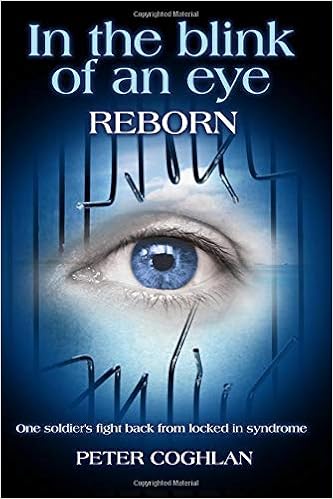
       In 2012, I received a phone call from my nephew Dan: 'Please could I help his great friend Peter to publish a book on his experiences with - and recovery from - Locked-in syndrome?'

      Following a massive brain stem stroke which almost killed him, Peter Coghlan awoke from a coma totally paralysed, unable to move anything except for his eyes.  He was entombed by Locked-in syndrome (LIS), an extremely rare and little understood condition which may affect severe stroke or brain injury sufferers.

       Of course I would help. Who could refuse to share in such a remarkable story….that of a young man breaking free from his own body! Over the next few months of emailing, skyping and editing his writings, I came to know Peter very well – well enough to realise he was a very special person.

       But I didn’t appreciate just HOW special he was until I read the following email in response to a recent heartfelt plea from Peter – that his story be remembered for the benefit of other stroke and locked-in survivors. His refusal to accept that he would never walk or talk again resulted in the fastest known recovery from locked-in syndrome previously recorded, giving hope and inspiration to other survivors who, like Peter, refuse to lie down!

Pete (left) with his fitness instructor Warren

To All General and Neurological Practitioners, Hospitals, Stroke Specialists, Therapists and Stroke Support Groups worldwide:

“Peter Coghlan has done so much to inspire other stroke survivors.  He is a role model for "life after stroke" and must be the one in a million to live to tell the tale.

I have read Jean-Dominique Bauby's book: 'The Diving Bell and the Butterfly' (but how many have?) and he never recovered his full mobility or lived long enough to jump hurdles and return to the workforce.* 

Peter's book: 'In the Blink of an Eye - Reborn' is a true account of the devastation to the lives of all stroke survivors.  Our group has been touched by his story and his dedication to assist others on a voluntary basis at hospitals in Perth WA.

Invite him over to speak at your conferences.  Use living images so that others can marvel in the technology that saved his life.”

Sally Allen (Coordinator/Secretary/Founder Member)
The Northern Suburbs Stroke Support Group inc.


Pete today

*Peter Coghlan is now a qualified health care worker, cycles, competes in marathons, plays the guitar, and has written a book, which he hopes will inspire other locked-in survivors. Not bad for a man few thought would ever walk, talk or do anything other than blink his eyes again!


https://www.amazon.com/Blink-Eye-Reborn-Peter-Coghlan/dp/1727145593/ref=sr_1_1?ie=UTF8&qid=1544017181&sr=8-1&keywords=in+the+blink+of+an+eye+reborn+peter+coghlan