Showing posts with label paralysed. Show all posts

Friday, 26 June 2020

The Purple Cave - Extract 'Flight from Fernilee'

Slowly and steadily, they continued along an underground river, the tunnel now so dark and narrow Odi began to hyperventilate again.
"Just what I need," he whined, "another bout of close-to-phobia!"
"Claustrophobia," Alice corrected him. "Seems pretty close to me!" replied Odi, for once unable to think of anything clever to say. To his great relief, they soon reached another, bigger cavern. So big, in fact, it resembled a magnificent palace, adorned with shafts of sunlight from above. As the Judith Mary approached its mooring, coming to rest on the banks of a crystal lagoon, all aboard gaped in astonishment.  Not only was the cavern wonderfully bright and airy, it was like no other they had ever seen before.
"It's purple!" Joe cried. "All purple and shiny!"
"We must be in the Blue John mines." Laurel suggested.
"But it's purple!" insisted Joe.
"Blue John IS purple, Silly," Alice tutted despairingly. "Don't you boys know anything?"
"Oh, so that's why it's called blue!" said Odi with a good dollop of sarcasm. "The stuff's purple, so naturally, you call it Blue. That's cool, and not at all confusing!" – Flight from Fernilee*

Samples of Blue John at Castleton Heritage Centre

No wonder Odi was confused. Despite its name, Blue John – a semi-precious stone from Castleton in Derbyshire – is generously threaded by bands of purple which tend to predominate.
However, there is also a yellow banded variety of this rare fluorite and one theory is that, during the reign of Louis XVI, it was exported for use by French ormolu workers who dubbed it ‘bleu-jeune’ (or ‘blue- yellow’ to Derbyshire folk like me!) Another source for the Blue John name may be miners drafted in from Cornwall. They referred to the stone as ‘bleujenn’, a Cornish term for a flower or blossom.
According to “Gem of the Peak” by 19th century writer William Adam, Blue John was discovered by the Romans but, as no evidence has ever been found for such a claim, we might put it down to historical embroidery! What we DO know is that Blue John was a popular material for fireplace panels during the mid-18th century. A Blue John plaque dated around 1760 can be seen in the Friary Hotel in Derby, while Robert Adam, the famous architect and interior designer used it to decorate nearby Kedlestone Hall.
At their 18th century peak, the Blue John Cavern and Treak Cliff Cavern in Castleton (the only sites in the UK where Blue John is mined*) produced 20 tons per annum. By the late 19th century, 3 tons per annum was mined, a figure further reduced to a mere half a ton today. Castleton is highly protective over its unique resource which is why all items made from Blue John, such as boxes, pots, vases and distinctive jewellery, are created by local craftsmen.
*The only other place where Blue John can be found is the Deqing Fluorite mine in the Zhejiang Province of China.
*Flight from Fernilee is available from Amazon


Saturday, 11 July 2015

Locked-in stroke survivor helps others have hope

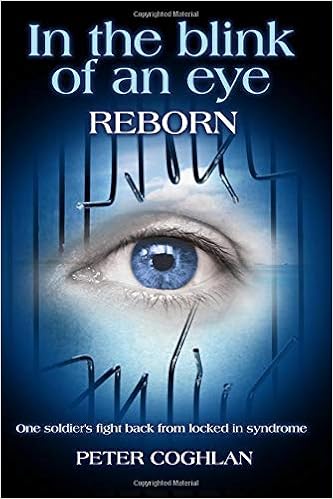
       In 2012, I received a phone call from my nephew Dan: 'Please could I help his great friend Peter to publish a book on his experiences with - and recovery from - Locked-in syndrome?'

      Following a massive brain stem stroke which almost killed him, Peter Coghlan awoke from a coma totally paralysed, unable to move anything except for his eyes.  He was entombed by Locked-in syndrome (LIS), an extremely rare and little understood condition which may affect severe stroke or brain injury sufferers.

       Of course I would help. Who could refuse to share in such a remarkable story….that of a young man breaking free from his own body! Over the next few months of emailing, skyping and editing his writings, I came to know Peter very well – well enough to realise he was a very special person.

       But I didn’t appreciate just HOW special he was until I read the following email in response to a recent heartfelt plea from Peter – that his story be remembered for the benefit of other stroke and locked-in survivors. His refusal to accept that he would never walk or talk again resulted in the fastest known recovery from locked-in syndrome previously recorded, giving hope and inspiration to other survivors who, like Peter, refuse to lie down!

Pete (left) with his fitness instructor Warren

To All General and Neurological Practitioners, Hospitals, Stroke Specialists, Therapists and Stroke Support Groups worldwide:

“Peter Coghlan has done so much to inspire other stroke survivors.  He is a role model for "life after stroke" and must be the one in a million to live to tell the tale.

I have read Jean-Dominique Bauby's book: 'The Diving Bell and the Butterfly' (but how many have?) and he never recovered his full mobility or lived long enough to jump hurdles and return to the workforce.* 

Peter's book: 'In the Blink of an Eye - Reborn' is a true account of the devastation to the lives of all stroke survivors.  Our group has been touched by his story and his dedication to assist others on a voluntary basis at hospitals in Perth WA.

Invite him over to speak at your conferences.  Use living images so that others can marvel in the technology that saved his life.”

Sally Allen (Coordinator/Secretary/Founder Member)
The Northern Suburbs Stroke Support Group inc.


Pete today

*Peter Coghlan is now a qualified health care worker, cycles, competes in marathons, plays the guitar, and has written a book, which he hopes will inspire other locked-in survivors. Not bad for a man few thought would ever walk, talk or do anything other than blink his eyes again!


https://www.amazon.com/Blink-Eye-Reborn-Peter-Coghlan/dp/1727145593/ref=sr_1_1?ie=UTF8&qid=1544017181&sr=8-1&keywords=in+the+blink+of+an+eye+reborn+peter+coghlan